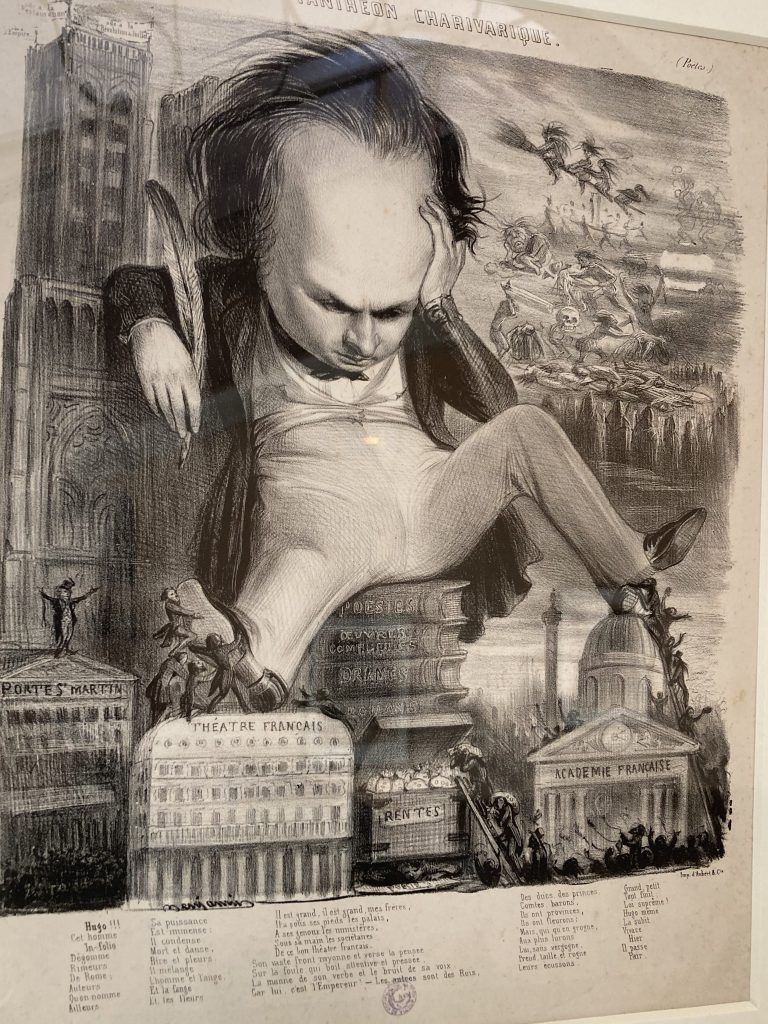
My first visit to Maison de Victor Hugo Paris took place in October 2018. At that time there was a temporary exhibition on caricatures of Hugo by his contemporaries, which I found memorable for a number of reasons, but mainly for the walls and walls of Hugo’s massive forehead. Apparently, this was the one thing that everyone who wanted to make fun of Victor Hugo chose to focus on. I spent an enjoyable afternoon going through each plaque, and exploring why a particular caricaturist or journalist or polemicist had disagreed with Hugo, and what the historical context of their disagreement had been. It was striking that an institution dedicated to venerating Victor Hugo, as this museum very much was, had chosen to exhibit these less venerable aspects of his life. Since then, I’ve made an effort to visit Maison Victor Hugo whenever I’m in Paris. The exhibitions have continued to be consistently excellent; their connection to Hugo is often a stepping-stone rather than a direct focus on some aspect of his life – an occasion for curating, one might say, rather than a traditional house-museum.
The current exhibition, ‘Hugo and Architecture: from stone to pen’ is a combination of the two, and I cannot recommend it enough.
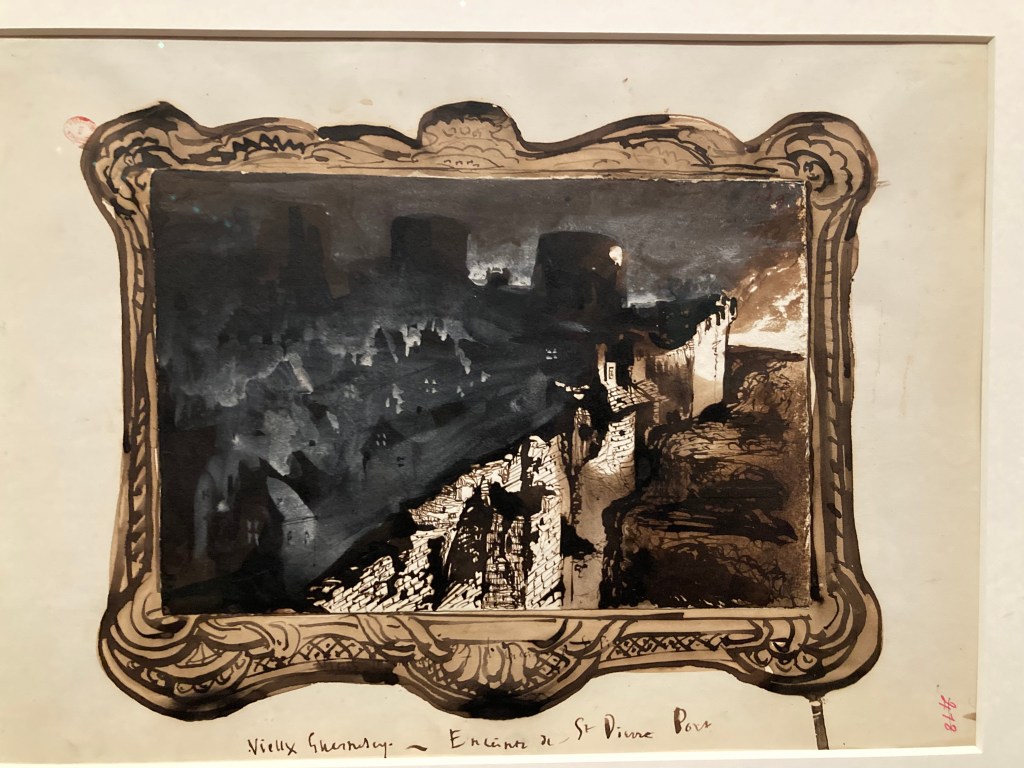
As was common for people of his age and class, Hugo kept a sketchbook in which he would draw what he saw and admired: castles on the Rhine during his travels, ruins and hills and towers, cathedrals whenever possible (there is a noticeable interest in sacred architecture) and vistas over dramatic landscapes. Such a habit of sketching crops up throughout the literature of the period, but what might seem remarkable to our modern eyes is that people who do this are not professionals, and for the most part have no desire to become one. They draw simply for the pleasure of it, as a hobby, without any hope or intent of profit. That we now no longer do this (there are of course exceptions, but let’s say it’s not a common thing) is perhaps due to the advent of photography – it is so easy to just take a picture of a beautiful mountain! Yet I suspect there is something inherently valuable in taking the time to put pencil to paper, and exerting yourself to find some connection between the eye and the brain and the hand. Even if the end result is not so magnificent – and this is the other noteworthy point, that people would do this even if they weren’t so good at it – it can still be a rewarding exercise. One of those things like writing a poem for a special occasion, which people used to do as a standard creative response to an event, without having to identify themselves as creatives.
All of which is to say that I was myself persuaded to purchase a fancy sketching book at the museum and now, to do honour to my purchase, I must pick up the habit of sketching.
To return to Hugo – his ink-paintings and drawings were certainly good enough to compete with professional artists, which must have been irritating for his contemporaries, considering that he was already known as a talented poet, playwright, novelist etc, and known also for his somewhat arrogant attitude concerning his own artistic genius. What you find in the exhibition is a selection of mainly inked sketches, some drawings, focusing on buildings with interesting architectural features, and occasionally, only the feature without the rest of the building. They range from the 1830s to the 1870s, and include also sketches that have been incorporated into his written work, such as pages from Notre-Dame de Paris and Ruy-Blas. The exhibition catalogue tells me that Hugo had read and was familiar with the main scholarly writings of his time concerning architecture; and moreover, that he had a stated preference for imagination over observation; and that he didn’t travel much outside France, with the exception of Belgium and the Rhine valley. This adds another dimension to the question of sketching, as an interaction with the human brain via human interpretation; for Hugo, it seems, it offered a chance to move beyond a mere technical fidelity to the object before him, which was perhaps more rewarding, as a creative response, but also more challenging. We can all see that sometimes it’s just more fun to add an extra gargoyle.
I would also emphasise that Hugo was not merely a skilled artist in terms of producing accurate and interesting architectural drawings – the works exhibited here are breath-takingly gorgeous art. Treat yourself and go see them if you can; they will bring joy to your brain.
The exhibition is on until 22nd November 2026.
https://www.maisonsvictorhugo.paris.fr/paris/expositions/hugo-et-larchitecture

