Marais
After leaving Victor Hugo, I had a leisurely wander through the Marais; busy as always, but the mood on the street was bright, everyone visibly relishing the last days of summer – and considering that this had been a summer with seven-odd heatwaves, it was lovely to be actually able to spend some time outside. It was also the Paris Design Week and some of the buildings were unusually open to the public. At the Hôtel d’Albret the stone courtyard had been turned into a pop-up café, which gave me a chance to have a sit down and some espresso. There were young people, and fashionable clothes – possibly an influencer, to judge from the intensive photographing that was going on, but these days you can’t really tell – perhaps a wannabe influencer – and so I found a nook out of their way and admired the architecture. I’d been drawn in by the name, but it turned out that the house had nothing to do with Jeanne d’Albret or the House of Navarre, but rather was named after a much later d’Albret. Nevertheless, there were some delightful architectural features, and I learned that the house had been built in 1545, and had at one point been the residence of Constable Anne de Montmorency.
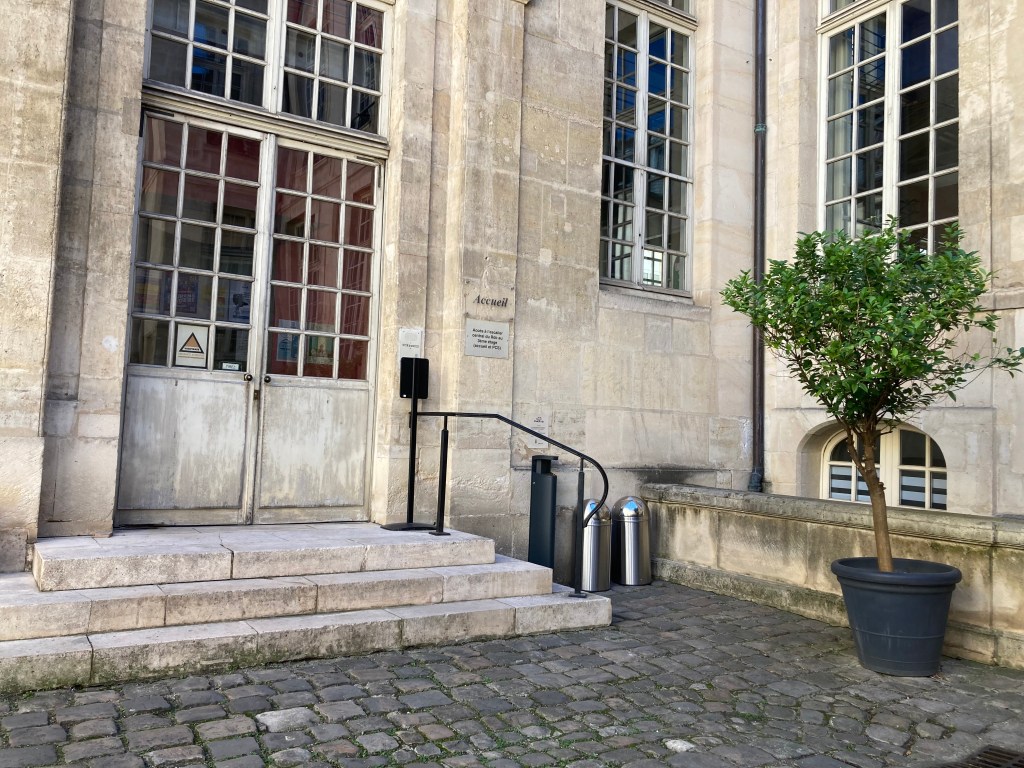
Musée Carnavalet
At that point I wasn’t far from Musée Carnavalet, so I figured I might as well, since it is both free and has good toilets, as well as an enormous and fascinating collection of historical artefacts – I usually end up going there, even without planning to, whenever I visit Paris, and it is always a pleasure. This time I started with the hall of tavern signs, noted two news ones, and proceeded to the section on ancient Paris, underground and easily missed if you don’t happen to go that way. From there straight upstairs, avoiding the 16th– and 17th-century spaces, and up to the Revolution.
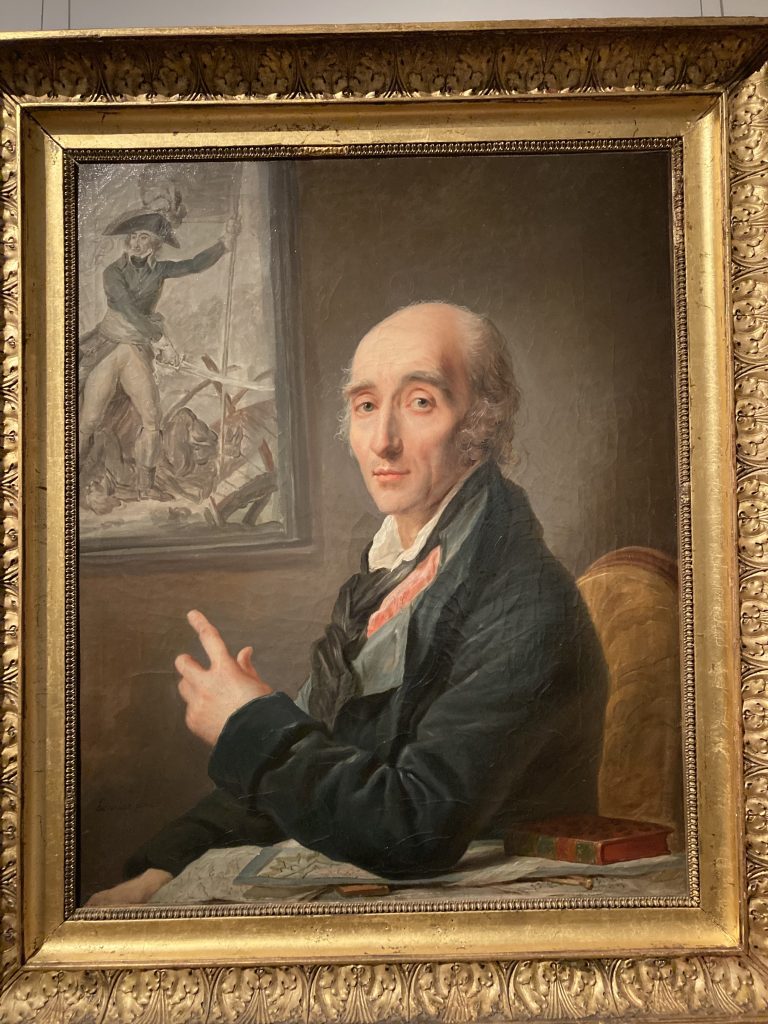
There are particular favourites that I like to stop by – the maquette of the Bastille, for one – but generally I tend to meander quite slowly when I’m there. For reasons that don’t need exploring at this juncture, I am always reading something about the French Revolution, and it often happens that something I am reading about comes to my attention at Musée Carnavalet. On this occasion, two portraits: Etienne Méhul (I’ve been listening to his symphonies recently) and General Charles-Pierre Augereau, a contemporary of and competitor to Bonaparte.
What makes his portrait particularly delightful is the way in which it engages with his career in the army of the First French Republic, and specifically, the PR battles of the period. Augereau is pointing at a smaller painting within the frame, a real painting of himself on Pont d’Arcole, a famous battle during the Italian Campaign of 1796; a real painting from 1798, painted by Charles Thévenin. About this battle there was a considerable amount of hagiographic propaganda according to which Bonaparte particularly distinguished himself, including a painting by Le Gros. Nevertheless, according to early reports, it was Augereau and not Bonaparte who did the heroic deeds (there is even an account of Bonaparte being pushed into a ditch by his own men). We can suppose that the earlier painting was an attempt to correct the then-popular view about Bonaparte’s heroism; I like to think that the second, painted during the Empire, was an attempt at some form of plaintive spite, as well as, probably, a reminder of his earlier successful military career.
Other things to note:
Robespierre’s shaving bowl, decorated by flowers, and I always wonder why he wouldn’t have had a revolutionary one since those were available. One of the ones that say ‘la liberté ou la mort’ at the bottom. You can find examples (plates rather than shaving bowl, to be exact) at the Musée de la Révolution Française in Grenoble, or indeed at the V&A in London. Unfortunately, neither museum offers reproductions of such delightful items.
Couthon’s wheelchair, an example of disability-inclusivity at the Convention. Apparently he also had two assistants who carried both him and the chair whenever stairs intruded.
Camille Desmoulins’ inkpot, presumably the one with which he penned Le Vieux Cordelier, and which therefore made me feel a Small Emotion (and afterwards, enjoy a Large Viognier). In the introduction to the Belin edition, the editors remark that having consulted Desmoulins’ handwritten corrections they experienced ‘l’émotion qu’on imagine’, the emotion such as you might imagine, when faced with these traces of Desmoulins’ hand. I like this acknowledgement that one would have an Emotion and I can’t deny that I did. But it also reminds of a question I like to poke at, which is why do we care about such things? The physical objects that once touched some notable figure from history, whether Robespierre’s shaving bowl or Marie-Antoinette’s shoe. Is it simply a matter of what survives, and therefore what gets put into museums? Some remnant of object-worship, akin to the bones of the saints? I do not have an answer, but since I am myself having this Emotion, it is worth my while to keep pondering.
My first proper encounter with Camille Desmoulins came from Hilary Mantel’s A Place of Greater Safety (1992), and I’m aware of how much that reading has affected my views on him. For all that I disagree with certain of his opinions and with many of his actions, he is, nevertheless, my blorbo, due to Mantel’s compelling characterisation and my subsequent research into his own writings. While I can see where Mantel’s version of Desmoulins comes from, I would lean towards a slightly different direction in portraying him – and of course, writing in the 2020s I have access to a lot more research about him and his time than Mantel would have done in the 1970s – one point which we agree on is that this was a man who delighted in being deliberately irritating. I’ve had friends tell me that this is something they hate about Mantel’s Camille, but to me he is perfect, and this is why he is my blorbo; and also because what you can see from his surviving works is that he was a writer more than anything else, a man who fashions himself through his writing and in gleefully smashing through the expectations of appropriate literary conduct.
In the Musée Carnavalet you can also find a portrait of Desmoulins, in which he looks a little determined, a little sulky and peevish, and possibly like he has a cold. I always give him a nod when I pass by.

